Advertiser Disclosure
BestBroadwayMusicals.com is an independent website. Content published on this site may be authored by individual contributors whose views may not necessarily reflect the views of BestBroadwayMusicals.com or any other organization. We may receive commissions on purchases you make through links published on our website. Click here to review our disclosures page for more information.
British Shows on Broadway: Why Some London Hits Soar and Others Sink
Broadway fans may have noticed there’s something in the air lately, and we’re not talking about the Manhattan pollution! But the sweet scent of tea and scones, fish and chips, and a wave of hit British shows on Broadway. Our analysis suggests that almost 20% of the latest Broadway season transferred from London, including Tony-nominated productions such as Two Strangers (Carry a Cake Across New York), Giant and Oedipus. That is up from 17% in the 2024–25 season and almost double the 2023–24 season, when around 11% of Broadway productions had crossed the Atlantic.
British imports are certainly not a new phenomenon. They ushered in the era of the megamusical in the 1980s and long-running musicals like Cats, Les Miserables and Phantom of the Opera defined Broadway for decades. Billy Elliot, Matilda the Musical and Harry Potter and the Cursed Child later proved that British theater could still deliver a blockbuster Broadway event in the 21st century. But success in the modern age is anything but guaranteed. For every transfer that becomes a Tony-winning sensation, another arrives in New York only to discover that Broadway can be a far less forgiving climate. So why do some London hits thrive in America, while others collapse almost on arrival?
What Counts as a British Transfer?
The ‘ West End’ is London’s equivalent of Broadway, attracting more than 17 million theatergoers each year. It comprises around 40 venues, including the Sondheim Theatre, Apollo Victoria Theatre and Noel Coward Theatre. But British theatre’s Broadway pipeline is not limited to the West End. There is also a dense network of subsidized and nonprofit theatres whose work regularly transfers into the West End and beyond: the National Theatre, Almeida Theatre, Donmar Warehouse, Royal Court, Bridge Theatre, Young Vic and others. Think of these venues like the Public Theater, Roundabout Theatre Company, and Manhattan Theatre Club here in New York City, and the major regional nonprofit sector across the US.
British transfers to Broadway specifically refer to productions that originated at one of these UK venues, rather than a new American-led production of a British show. Jamie Lloyd’s Tony-winning revival of Sunset Boulevard, starring Nicole Scherzinger, was a direct transfer from London’s Savoy Theatre. By contrast, the recent Broadway revival of Chess was a new production of a musical that first premiered in London in 1986.
British Shows on Broadway Now

& Juliet
& Juliet arrived on Broadway after becoming a smash hit in London’s West End, where its inventive premise and pop-powered score won over audiences. Featuring the songs of Max Martin, this British-born musical reimagines Shakespeare’s heroine Juliet with a contemporary twist...what if she forged her own path after Romeo?

Harry Potter and the Cursed Child
Harry Potter and the Cursed Child has become a global theatrical phenomenon. Created by Jack Thorne, J.K. Rowling, and John Tiffany, the Olivier Award-winning production brought its groundbreaking stagecraft and magical storytelling across the Atlantic, where it continues to be one of Broadway’s biggest attractions.

Operation Mincemeat
Operation Mincemeat arrives on Broadway after becoming a surprise sensation in London’s West End. Created by the British comedy troupe SpitLip, this inventive musical comedy transforms a real-life World War II deception mission into a fast-paced comedy. It's equal parts absurd, heartfelt, and hilarious.
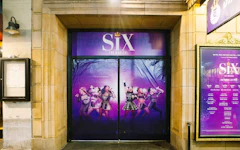
Six
Six began its life at the Edinburgh Fringe Festival before growing into a West End and international phenomenon. Created by British writers Toby Marlow and Lucy Moss, the pop musical reimagines the six wives of Henry VIII as modern pop stars, turning a distinctly British piece of history into a Broadway blockbuster.

Stranger Things: The First Shadow
Stranger Things: The First Shadow makes the leap from London to Broadway after earning rave reviews in the West End. Developed by the creative team behind the hit Netflix series, the production combines theatrical spectacle with supernatural storytelling.

Two Strangers (Carry a Cake Across New York)
Two Strangers (Carry a Cake Across New York) transfers to Broadway after winning audiences over during its celebrated London run. This charming British musical follows two unlikely companions navigating New York City. Seeing NYC from an outside perspective will make you fall back in love with the big apple!
Why Some British Shows Become Broadway Hits
Broadway is full of uncertainty, and no show is guaranteed success, regardless of its heritage. But it does appear that an increasing number of British-originated productions are arriving in New York with genuine momentum.
One reason is that, for many American theatergoers, British theater carries prestige. Broadway may dominate as the global capital of commercial theatre, particularly the musical, but London is often seen as a home for serious playwrights and bold directors. The subsidized sector allows writers to be nurtured over time in venues such as the National Theatre, Royal Court and Almeida before becoming internationally recognized names. In recent years, writers including Tom Stoppard, James Graham and Jez Butterworth have all enjoyed major Broadway success.
Directors can carry just as much weight. Productions helmed by figures such as Sam Mendes, Marianne Elliott, Rebecca Frecknall and Jamie Lloyd often arrive on Broadway in a frenzy of anticipation and buzz. London often feels like a theatrical laboratory where bold visions can be tested, reviewed and approved before they reach New York.
That sense of legitimacy has helped recent British plays arrive on Broadway not merely as entertainment, but as cultural ‘must-see’ events. Leopoldstadt, The Lehman Trilogy and The Ferryman, all transferred with significant London reputations and went on to win the Tony Award for Best Play. Each show’s British origin was certainly not the only selling point, but it did tell Broadway audiences that they were worth their time and money.
Star power also matters. Like Broadway, the West End attracts major screen actors, and a star-led London success can often mark the precursor of a New York transfer. John Lithgow in Giant, Jodie Comer in Prima Facie and Sarah Snook in The Picture of Dorian Gray all proved their star power and acting prowess, making their productions must-see events for Broadway audiences. The upcoming Broadway transfer of Much Ado About Nothing, direct from London’s Theatre Royal Drury Lane, has a similar aura: Shakespeare, Tom Hiddleston and Jamie Lloyd converging in a single production. The show feels quintessentially British, arriving on Broadway as a package of theatrical prestige and megawatt star power.
The Economics of British Musical Transfers
Mounting any Broadway production is expensive, but musicals are in a category of their own. The average initial capitalization for new Broadway musicals has now climbed to around $19 million, and the largest productions can cost far more. That creates a sobering challenge for even the most successful British producers. A musical that is a hit in London may still be a terrifying financial proposition in New York.
Broadway’s economics are especially brutal because the costs do not stop at opening night. A major musical can have weekly running costs well into six or seven figures once salaries, real estate, royalties, marketing, and other operating expenses are included. A hit show can gross what sounds like an enormous amount of money and still be hovering around break-even at best, or even hemorrhaging money.
These daunting fiscal realities partly explains why British musical transfers increasingly seem to be capitalising on a “less is more” model. Some of the most successful recent examples are not trying to compete with the scale of Moulin Rouge!, Wicked or Death Becomes Her. Instead, they arrive with compact casts, simple sets and a highly marketable premise.
Two Strangers (Carry a Cake Across New York), one of the breakout successes of the 2025–26 Broadway season, has a cast of two, a single set, and a simple premise: a cheerful Brit and a jaded New Yorker embark on a 48-hour romp across the city with a wedding cake. Operation Mincemeat has followed a similar path. It began in a 77-seat fringe theater in London in 2019, aided by a modest £14,000 government grant, before growing into a West End hit and then crossing the Atlantic. On Broadway, it still depends on the same core engine of five performers playing more than 50 characters, operating the largely-manual set themselves.
And one of the biggest British musicals of the last decade, SIX , also utilizes this smaller format. The six wives of King Henry VIII perform a pop concert. It’s each Queen’s palpable energy and star quality that fills the stage, rather than a lavish, expensive set. This smaller scale allows for cheaper (in Broadway terms!) capitalization and running costs. Mincemeat was reportedly mounted on Broadway for around $11.5 million and has weekly costs of around $500k, while Two Strangers only raised $8 million with weekly costs under $500k. That’s still a lot of money, but not when compared to shows like The Lost Boys($25 million) and Death Becomes Her($31.5 million). A smaller, distinctive, easily marketable musical can afford to grow by word of mouth. A massive musical has far less room for uncertainty.
The New York Times reported that of the 46 new musicals that opened since the Coronavirus pandemic, only three have become profitable. Andrew Lloyd-Webber, perhaps the most successful British musical theater composer of all time, has complained that “Broadway is no longer a business. I look at the economics of this, and I just don’t see how it can sustain.”
The other major trend is the radically reimagined musical revival. In recent years, London has become a laboratory for classic musicals staged in exhilaratingly fresh and inventive ways. Jamie Lloyd’s ‘minimalist maximalist’ productions of Sunset Boulevard and Evita , the in-the-round Cabaret at the Kit Kat Club, and the gender-swapped version of Stephen Sondheim’s Company all became the talk of the town in London’s West End.
London’s theater culture is particularly suited to this. British audiences are used to radical reinterpretations of classic work, from Greek tragedies and Shakespeare to Chekhov and Sondheim. Directors are granted the agency to offer bold, conceptual takes on classic works, reframed for modern audiences. When those productions work, Broadway can import not just the title, but the the reviews, awards, and hype.
 Play the video
Why Some Major London Hits Fail in America
But a London hit does not automatically translate into Broadway success. When a production crosses the Atlantic, it enters an entirely different cultural ecosystem. Broadway has higher costs, different audience demographics, and often an alternative relationship to the subject matter. A production that felt bold and stylish in London can arrive in New York feeling underpowered and overproduced.
Tammy Faye is one of the most notable recent examples. At London’s Almeida Theatre, it had a powerhouse British creative team taking on a fascinating American phenomenon. The world of Tammy Faye Bakker could be treated as a bizarre American carnival. On Broadway, however, audiences were much closer to the material and likely to have their own reflections on televangelism and the real Tammy Faye.
Similarly, Lucy Prebble’s play Enron(2009) was acclaimed in London, where the collapse of the corporation could be processed as a scathing critique of capitalism. On Broadway, the scandal was not foreign material and New York audiences may have been less willing to accept a stylized British account of an American financial scandal. This is also perhaps why The Lehman Trilogy succeeded where Enron failed, when they both examined similar subject matter. The former mythologized its subject, turning the rise and collapse of a financial dynasty into epic theatre, using the subject to tell a wider story about the American Dream. Enron, by contrast, risked appearing like a clever British lampooning of American greed.
Cultural disconnect is rarely the only problem, though; it often overlaps with the brutal economics of staging a Broadway show. Tammy Faye did not merely transfer from London to Broadway, it moved directly from the 300-seat Almeida to the mammoth 1,600-seat Palace Theatre at a reported cost of around $25 million. At that scale, a Broadway musical cannot survive as a curiosity for theater fans. It needs sustained demand from tourists, locals, groups and casual buyers. It also quickly needs to establish healthy advance sales, a clear identity in the crowded marketplace, and strong reviews and word of mouth. Tammy Faye failed to secure any of these crucial elements, and closed after just 24 previews and 29 regular performances, reportedly losing its entire investment.
This problem is not unique to British transfers. Off-Broadway shows can suffer the same fate when they move into larger Broadway houses. A production that feels thrilling in a small room can become diluted when the venue is larger, the ticket price is higher and the expectations are more commercial.
The Future of British Transfers
Broadway success can often look like a lottery, but the recent wave of British transfers suggests something more interesting than pure chance. A show may arrive from London with rave reviews and awards momentum, but none of that guarantees it will survive the journey. Yet Broadway is looking to London with renewed appetite. For New York producers, the UK offers a valuable testbed and a place where new productions can build strong foundations before facing Broadway’s harsher commercial realities. For British producers such as ATG and Sonia Friedman, the potential rewards are enormous, even if the risks are equally stark.
Those risks don’t only operate one-way. Broadway hits can also struggle to connect with West End audiences. Ain’t Too Proud was forced to close early after poor sales, and MJ the Musical managed only two years in the West End, while it remains one of Broadway’s top-grossing shows.
For theater fans, that uncertainty is part of the thrill. The growing two-way traffic between London and New York has made shows feel more interconnected than ever. Every transfer now arrives with the same interest and intrigue. Will it be the next great Broadway sensation, or another cautionary tale from across the pond…
About the author

Nathan Pearce
Contributing Writer
Nathan Pearce is a London-based freelance writer with a passion for theatre on both sides of the Atlantic. Throughout his career, he’s worked across newspapers, magazines, and online for the creative industries, technology sector, and more. When he’s not writing or at the theatre, you’ll find him at a concert, buried in a book, or giving some much-needed love to his growing collection of house plants.