1. Home
  2. /
  3. Choosing a Show

Broadway Shows with Special Effects: The Definitive Guide

Recommendations
Published on: Apr 16, 2026
By: Nathan Pearce
Share Article
harry-potter-cursed-child-at-lyric

Broadway has always thrived on a little bit of magic. Long before Hollywood introduced blockbuster CGI, New York theatre-makers were well versed in finding ways to make the impossible feel real.

Over the years on Broadway creatives have raised the bar to ever-more jaw dropping levels, from crashing chandeliers and magical flying carpets, to disappearing actors and time-travelling cars. But unlike film, there are no retakes or post-production safety nets. Every illusion has to work perfectly, night after night, with a live audience just a few feet away. It’s this combination of precision, creativity and risk that gives Broadway theater its unique edge, and why even the smallest effect can feel so impactful.

Theatrical spectacle can be traced back thousands of years to ancient Greek theater, which featured a role known as the “Worker of Wonders,” responsible for creating onstage miracles. Renaissance theatre in the 15th and 16th centuries introduced flying machines and trapdoors, while the Victorians applied the technologies of the Industrial Revolution to create elaborate spectacles, including onstage fires and large-scale mechanical scenery.

On Broadway, special effects as we know them today became especially prominent during the era of the megamusical in the 1980s. Andrew Lloyd Webber’s The Phantom of the Opera featured a giant chandelier that came crashing down above the audience’s heads, while Miss Saigon in the 1990s showcased a life-sized helicopter descending onto the stage. 

Today’s Broadway productions use a wide mix of traditional stagecraft and cutting-edge technology to defy the limits of traditional theater. Have you ever wondered how your favorite shows like Harry Potter and the Cursed Child, Stranger Things: The First Shadow, or Maybe Happy Ending create their awe-inspiring special effects?

Join us for a behind-the-scenes look at how Broadway creators use everything from projection mapping and automation to lighting and sound design to bring their stage illusions to life. We’ll also explore who creates these effects, the pros and cons of big-budget spectacle, and which Broadway shows with special effects you should add to your bucket list. 
Glossary of Special Effects on Broadway

Special effects on Broadway can be broadly defined as a design discipline which encompasses specialisms including pyrotechnics, atmospherics, mechanics, illusions, puppetry, fire, weather phenomena, and more. Each type of effect involves distinct challenges, techniques, and expertise to contribute to the overall ‘stage magic’.

Practical effects include real, physical elements like fire, falling snow, or onstage rain. Because they exist in the same space as the performers, there’s something undeniably thrilling about knowing that what you’re seeing is really happening with no digital trickery involved.

Mechanical effects focus on movement. This could mean entire set pieces sliding into place, stages that rotate, or performers being lifted into the air. Levitation, flying rigs and trapdoors all fall into this category, relying on engineering and precise timing to create smooth, believable motion.

Illusions are where theatre leans into deception. These effects are designed to hide their own mechanics, making objects appear, disappear, or transform in ways that feel impossible. Often inspired by traditional stage magic, they rely as much on choreography and misdirection as they do on physical equipment.

Projection and video effects bring a more digital layer to the stage. Using projection mapping and screens, designers can instantly transform environments, add movement to static sets, or create effects that would be difficult to achieve physically. These tools are especially useful for creating large-scale or rapidly changing visuals.

Atmospheric effects help shape the overall environment. Fog, haze, and wind effects might seem subtle, but they play a crucial role in making a scene feel real or otherworldly. They also enhance lighting, making beams visible and adding depth to the stage picture.

Behind all of this is the work of incredibly talented designers. Their role is to create illusions that draw the audience deeper into the world of the production, while ensuring that every effect is safe, reliable, and repeatable. Now we know the breadth of the different types of special effects utilized by Broadway shows, let’s explore some of the current roster of shows making audiences’ jaws drop.

Currently Running Broadway Shows with Special Effects

harry-potter-cursed-child-at-lyric

Harry Potter and the Cursed Child

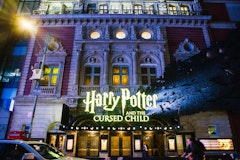
This Broadway production had huge shoes to fill when it came to bringing the Wizarding World to life on stage at the Lyric Theatre. Instead of relying on digital effects to recreate the CGI seen in the iconic film series, the Broadway creative team utilized many practical special effects to create the spells, wizardry and magical moments throughout the show. Characters vanish and reappear in an instant, dementors glide ominously through the theatre, and Polyjuice potion transformations happen right before the audience’s eyes. Many of these effects require precision timing and are achieved through a combination of hidden mechanics, trapdoors, clever lighting and misdirection that leaves audience members wondering how it was possible. One of the most impressive moments in the play is the Time-Turner effect, which uses projection mapping and hidden rigging to make the object appear to float while a ripple effect visually and audibly travels through the auditorium.

Stranger Things on Broadway

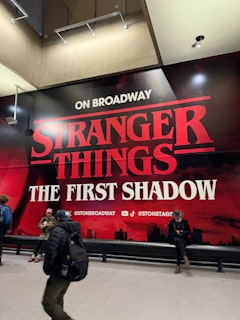
Stranger Things: The First Shadow

Stranger Things: The First Shadow brings a distinctly cinematic style of special effects to the Broadway stage, under Stephen Daldry’s ambitious direction. The production pushed Broadway technology to new limits that resulted in the Illusions & Technical Effects team receiving a Special Tony Award for their work. The Upside Down is recreated through a combination of practical effects and projection mapping, whilst a giant Mind Flayer looms over Henry Creel in a feat of automation, creature effects and precision timing that required part of the ceiling of the Marquis Theater to be removed. In total, Stranger Things: The First Shadow contains more than 60 unique special effects that require every department to work perfectly in sync during every single show. 

Maybe Happy Ending

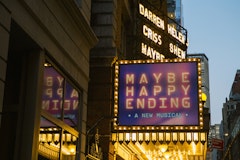
Maybe Happy Ending

Maybe Happy Ending utilizes video to extraordinary effect. The stage at the Belasco Theatre is filled with 450 LED tiles and multiple surfaces covering the ceiling, back wall, floors and proscenium – more than any other show currently on Broadway! The edges of each screen are disguised resulting in a seamless blend of lighting, scenery and video that leaves audiences in wonder. The Tony Award-winning Best Musical tells the story of two obsolete helper robots in a near-future Seoul who form an unexpected bond and set out on an unforgettable journey, all of which is told through a series of moving boxes and expanding screens to create a truly cinematic feel for the audience.

Aladdin & The Lion King

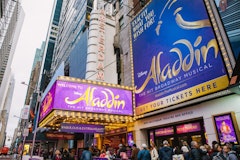
Disney has spellbound generations of theatergoers with their lavish stage adaptations of iconic films like The Lion King and Aladdin, both currently playing on Broadway. The Lion King uses a blend of traditional practical effects and puppetry to bring Pride Rock and its characters to life. The exhilarating wildebeest stampede is achieved using five levels of rotating rigs, scrolling backdrops and precise movement and mask work set against Hans Zimmer’s percussive music. Meanwhile, the most iconic special effect in Disney’s Aladdin is, of course, the magic flying carpet ride, which is achieved through a carefully concealed rigging system that allows it to glide and spin convincingly in mid-air. Meanwhile, the Genie’s magic is brought to life through a kaleidoscope of quick changes, smoke, and sleight-of-hand illusions.

Gershwin-Wicked-Broadway-Musical

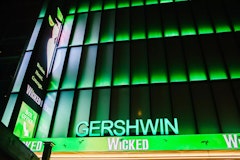
Wicked

Elphaba’s defiant rejection of the Wizard of Oz and evolution into ‘The Wicked Witch of the West’ as she sings the anthemic “Defying Gravity” has become one of the defining moments of Broadway theater. During the climax of “Defying Gravity,” Elphaba rises high into the air on a concealed lift system, supported by rigging, smoke, and lighting effects that create the illusion of flight. The show uses many other mechanical effects, including Glinda’s bubble, the Wizard’s huge puppet head, and the complex wire system for the flying monkeys. 

Death Becomes Her

Death Becomes Her

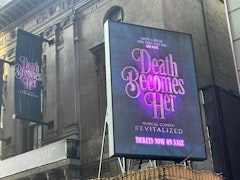
The creative team of Death Becomes Her on Broadway had a mammoth task recreating some of the iconic moments from the 1992 cult classic movie starring Meryl Streep. The side-splittingly funny 90-second staircase fall is achieved through perfectly-synchronized lighting, sound, costume and choreography from an Olympic gymnast-trained stunt double. The illusions team were inspired by 19th century magic tricks to recreate the infamous stomach hole, while Madeline’s headless turn (literally!) is pulled off with clever prop, costume and set design.

Who Creates Broadway’s Special Effects?

As we’ve seen in the above examples, creating the wide variety of special effects on Broadway is a truly collaborative effort, requiring multiple departments to be working perfectly in sync. However, there are a number of highly skilled specialists that Broadway productions hire to elevate their special effects and make the impossible, possible. 

Illusion/Special Effects Designers work closely with the director and creative team to figure out the logistics of turning the vision into reality. From huge practical effects to intimate atmospheric moments, they are responsible for bringing their inventions to life within the constraints of the theater’s space, budget and ensuring the effects can be administered safely for both the cast and audience night after night. 

For some shows where magic is a central part of the narrative like in Harry Potter and the Cursed Child, Magic Consultants are brought on board to ensure that any illusions or tricks feel grounded and real within the world of the material, striving to create effects that serve the narrative first and foremost. Magic consultants often have an encyclopaedic knowledge of illusion techniques and help integrate them seamlessly into the storytelling using modern theatrical tools. 

Are Special Effects on Broadway Worth It?

As the price of tickets continues to increase year-on-year, Broadway fans are becoming more discerning about which shows to spend their hard earned money on. Producers are seeking ever more ambitious ways to attract theatergoers. Creating ‘cool’ special effects or illusions is one of the most impactful tools in the producer’s playbook. Unforgettable moments like the iconic chimney sweep dance across London’s rooftops in Mary Poppins, the visual set and lighting extravaganza of Moulin Rouge! The Musical, or the time-travelling DeLorean in Back to the Future: The Musical show just how powerful these effects can be.

But these effects come at a cost. A major Broadway musical costs around $19 - 20 million to mount, on average. But shows with ambitious special effects can significantly increase this figure. Harry Potter and the Cursed Child cost around $68 million – the most expensive play ever staged. Meanwhile, the doomed Spider-Man: Turn Off the Dark was the most expensive Broadway production in history with a budget of $75 million. It’s no surprise that the majority of big budget special effects are major franchises like Stranger Things and Harry Potter. 

But bigger isn’t necessarily better. Sometimes all it takes is a simple piece of old-school theatrical magic to spellbind an audience. At the end of the day, Broadway’s greatest trick is making audiences believe that the impossible is possible. 

Nathan Pearce Headshot

Nathan Pearce

Contributing Author

Nathan Pearce is a London-based freelance writer with a passion for theatre on both sides of the Atlantic. Throughout his career, he’s worked across newspapers, magazines, and online for the creative industries, technology sector, and more. When he’s not writing or at the theatre, you’ll find him at a concert, buried in a book, or giving some much-needed love to his growing collection of house plants.


Education: University of Liverpool, Bachelor of Arts (B.A.) Journalism

Published

Mar 29, 2026

Share Story

We may receive commissions on purchases you make through links published on our website. Click here to review our disclosures page for more information.